Objective
Discrepancies between laboratory sodium and point-of-care arterial blood gas sodium values may lead to delayed interpretation of, and intervention on, the results. We studied the mean difference between these two techniques and assessed the degree of agreement.
Design
A multicentre, retrospective, observational study was conducted.
Setting
Twelve intensive care units in Queensland, Australia, with tertiary-level hospitals accounting for 81% of admissions were included in the study.
Participants
Adult patients with at least one paired laboratory sodium and arterial blood gas measurement during their intensive care unit admission were a part of this study.
Main outcome measures
Main outcome measures included mean difference between laboratory sodium and point-of-care sodium measurement, with a positive difference demonstrating laboratory sodium values higher than arterial blood gas sodium values.
Results
A total of 65,042 patients with 224,383 paired samples were included in the analysis. The Bland–Altman mean difference of laboratory sodium and arterial blood gas sodium was 0.72 mmol/L (95% limit of agreement [LoA]: 4.35) with a Deming regression slope of 0.93 (95% confidence interval: 0.92, 0.94) and intercept +10.07 (p < 0.001). On subgroup analysis of hyponatraemia, eunatraemia and hypernatraemia a mean difference (95% LoA) of 1.53 mmol/L (4.21), 0.15 mmol/L (4.39), and −1.02 mmol/L (5.37), was calculated, respectively. Patients with severe hyperglycaemia and normal albumin had a mean difference (95% LoA) of −1.85 mmol/L (4.78). Analysis of mild, moderate, and severe subgroups within both hyponatraemic and hypernatraemic samples showed increasing mean differences, with severe hyponatraemia showing a mean difference of 2.01 mmol/L (95% LoA: 8.08) and severe hypernatraemia showing a mean difference of −4.7 mmol/L (95% LoA: 15.46).
Conclusions
Point-of-care arterial blood gas sodium measurements show small mean differences in eunatraemia and good agreement with paired laboratory samples in adult intensive care unit patients. Caution should be applied when interchanging results between laboratory and point-of-care sodium values in patients with moderate to severe dysnatraemia, as serial measurements using different methods during treatment are unlikely to be within a clinically acceptable range. This is important when caring for patient groups with severe hyponatraemia and induced hypernatraemia, and serial measurement may be better achieved with point-of-care testing due to a combination of ease of access, repeatability, and lower cost.
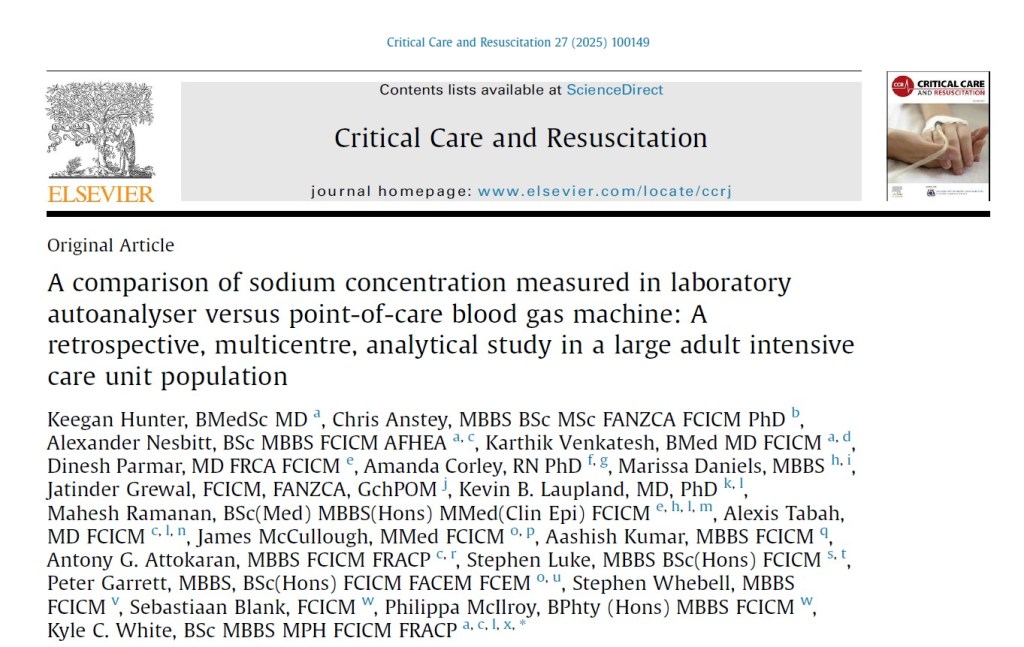
Hunter, K., Anstey, C., Nesbitt, A., Venkatesh, K., Parmar, D., Corley, A., Daniels, M., Grewal, J., Laupland, K. B., Ramanan, M., Tabah, A., McCullough, J., Kumar, A., Attokaran, A. G., Luke, S., Garrett, P., Whebell, S., Blank, S., McIlroy, P., & White, K. C. (2025). A comparison of sodium concentration measured in laboratory autoanalyser versus point-of-care blood gas machine: A retrospective, multicentre, analytical study in a large adult intensive care unit population. Critical Care and Resuscitation, 27(4), 100149.
Full Text: https://doi.org/https://doi.org/10.1016/j.ccrj.2025.100149
 Queensland Critical Care Research Network